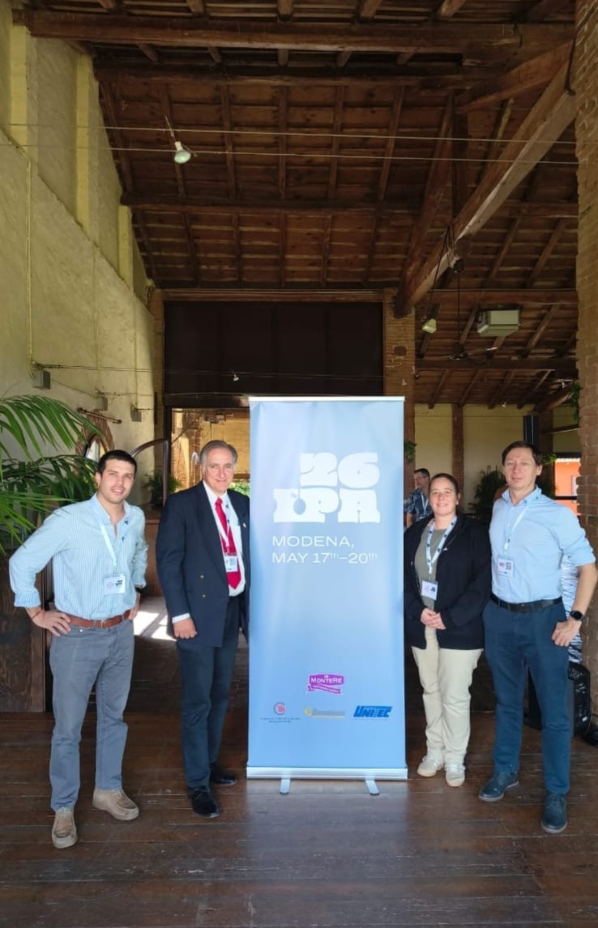
From May 17 to 20, 2026, the city of Modena, Italy, became the global epicenter of our industry by hosting the International Prune Association (IPA) Congress. Organized locally by the Cooperativa Modenese Essiccazione Frutta, the event brought together key players from producing countries such as the host Italy, along with Chile, California (U.S.), Argentina, France, South Africa, Australia, and China.
For the Chilean industry, this congress not only served to strengthen ties but also yielded several commercial and technical conclusions that reaffirm our leadership position in the market.
Regarding trends observed at the event itself and its exhibitions, in general, a tendency from recent years has been confirmed, pointing to a stabilization of global production volumes, with a scenario of controlled supply that has allowed prices to remain at levels that are favorable for producers such as those in Chile—who have substantially improved their quality and have been able to command higher prices— but not so for the rest of the world’s producers, who experienced a downturn some time ago and now see a stabilization in their selling prices that does not fully satisfy them.
The star of the event was Prunesco, one of the world’s leading exporters of this fruit and the top exporter in Chile. Led by its president, Jaime Lira—who is also a member of the IPA’s executive committee—the company was also represented by Juan Carlos Bozzo, plant manager; Rosario Larraín, agricultural manager; and Iñaki Erenchun, regional agronomist.
The company sent a reinforced team -plant management and field technical staff- to see what is being done in other countries, what works and what does not, particularly in terms of technology, emphasizing the importance of visiting machinery manufacturers in person—in this case, suppliers of stone-removal sorters.
As a member of the IPA’s executive committee, Jaime Lira comments on the organization’s desire to seek a “breath of fresh air” that will allow it to remain a relevant entity for each of its member countries.
In his analysis, he notes that the IPA faces significant challenges regarding the geographic dispersion of its members and the disparity of interests among participating countries. Even so, there is a vision for the future in which work is underway on a more modern model that will equip the IPA with better management tools, enabling it to demonstrate value to the industry and thus secure greater resources, and to lead projects relevant to the development and consolidation of prunes worldwide.
Perhaps the central theme of the conference was agriculture in the face of the climate crisis and the carbon footprint, and where we stand as an agricultural sector in terms of CO2 emissions and sequestration. While this is an urgent and immediate issue for European countries, for Chile it is a challenge being addressed more at the governmental level than the corporate level; “it is still a bit far away for us as industry,” although the need to prepare for growing global regulatory and environmental demands is recognized.
On the other hand, China will always be a topic at these meetings. The Asian giant, through the only company from that country that is a member of and participates in the IPA, presented a comprehensive report for 2025—unlike the rest, which provided this year’s figures and projections—though there is always uncertainty regarding the accuracy of the figures provided. Although agricultural development in China is less advanced than in Chile, any small technological leap—such as in its irrigation infrastructure—could impact the market unexpectedly, considering their 62,000 hectares of the D’Agen variety versus the 13,500 planted in Chile.
New Technologies and the Local Ecosystem
For his part, Juan Carlos Bozzo, Plant Manager at Prunesco, highlighted the strength and stability demonstrated by some of the industry’s most prominent players, as well as the challenges faced by other countries due to changes in market conditions and growing competition for agricultural land use.
The visit to MonteRè, he added, was an enriching experience that provided insight into the industry’s processes, technologies, and best practices, “leaving a very positive impression of the level of excellence and professionalism observed.” He also highlighted the friendliness, approachability, and willingness of their teams to share knowledge and experiences, which helped foster an atmosphere of collaboration and learning.
During the visit, the group had the opportunity to see a Phoenix machine, recently acquired by the Unitec Group, a renowned Italian company specializing in fruit sorting and grading technologies. “This solution demonstrates the potential for applying the expertise and technological know-how that Unitec has successfully developed for other fruit species to the plum sector. This integration process opens up opportunities for the development of new inspection and sorting tools, which can help further raise the industry’s standards of quality and efficiency.”
For Bozzo, the most fascinating aspect of the trip was discovering how the region’s rich agricultural history (the birthplace of balsamic vinegar and Parmesan cheese) intertwines with industrial and mechanical development. By visiting museums such as the Maserati Museum and being close to Ferrari or Lamborghini (which started out making tractors), he realized that the local automotive ecosystem simultaneously drove the development of the first large-scale packaging machinery (such as the ACMA brand in 1920).
“All this technological and academic heritage converges perfectly in the design of the modern agro-industrial plants I saw in the region,” he adds.