The Chilean prune industry is experiencing a season marked by a more cautious international market, particularly from China, although with historically high returns for exporters and domestic producers.
This is according to Sebastián Aguilera, Export Manager at South 365, a Chilean company specializing in the export of dried fruit and currently operating in 56 markets around the world.
“This year we have seen a Chinese market that has been much more cautious in its purchases. Last year, they came out strong and early, whereas now they have moved forward very cautiously, mainly looking for small calibers,” says Aguilera (*).
(*) This interview was conducted prior to INC. Following the event, the executive adds that prices are expected to rise.
Today, there are reportedly high levels of accumulated inventory of large sizes in China, which has dampened buying appetite at the start of the season. This situation has also indirectly impacted Europe, a market that accounts for nearly 60% of South 365’s exports.
“The price we aim for in China ends up influencing prices in Europe. If we want to sell at a higher price in China, we naturally try to push prices up in Europe as well. We started this year with high expectations, but the market ended up adjusting,” he notes.
Even so, the executive emphasizes that this is not a negative scenario for the industry. “When we talk about lower prices, we are referring to initial expectations, not historical returns. We are still at very good levels for Chilean prunes,” he says.
In fact, Aguilera notes that historically, returns for the industry ranged between US$0.80 and US$1 per kilo, while in recent years they have remained between US$1.70 and US$2 per kilo.
Currently, South 365 distributes its exports primarily to Europe (60%), China (30%), and the remainder to Mexico and Central America, as well as Brazil, which this year brought forward its purchases compared to previous seasons.
“Brazil is looking for small fruit and began closing deals earlier than in other years. These are interesting signs of how market dynamics are changing,” he notes.
Quality as a Strategic Hallmark
Beyond fluctuations in prices and demand, Aguilera emphasizes that one of the main challenges facing the Chilean industry is protecting the international standing of Chilean prunes.
“We understand that we are committed to the producers and that our responsibility is to defend the Chilean prune brand. Quality must be consistent,” he asserts.
Currently, South 365 works with about 25 producers and maintains internal standards that are even more demanding than those required by some markets.
The executive explains that quality begins at the source. “If poor-quality fruit enters the process, no amount of magic can transform it into a premium product. What goes in wrong ends up wrong,” he states.
For this reason, he emphasizes that both producers and exporters play a key role in the international reputation of Chilean products. “The final decision is always: does this truly represent what the Chilean prune stands for in the world?”
In addition to prunes, South 365 exports almonds, walnuts, and dried cherries, maintaining a model 100% based on consignment and with a constant focus on generating better returns for its partner producers.
With an increasingly globalized industry and more demanding consumers, Chile continues to consolidate its position as one of the world’s leading players in prunes, supported by quality, market diversification, and a reputation built over decades.
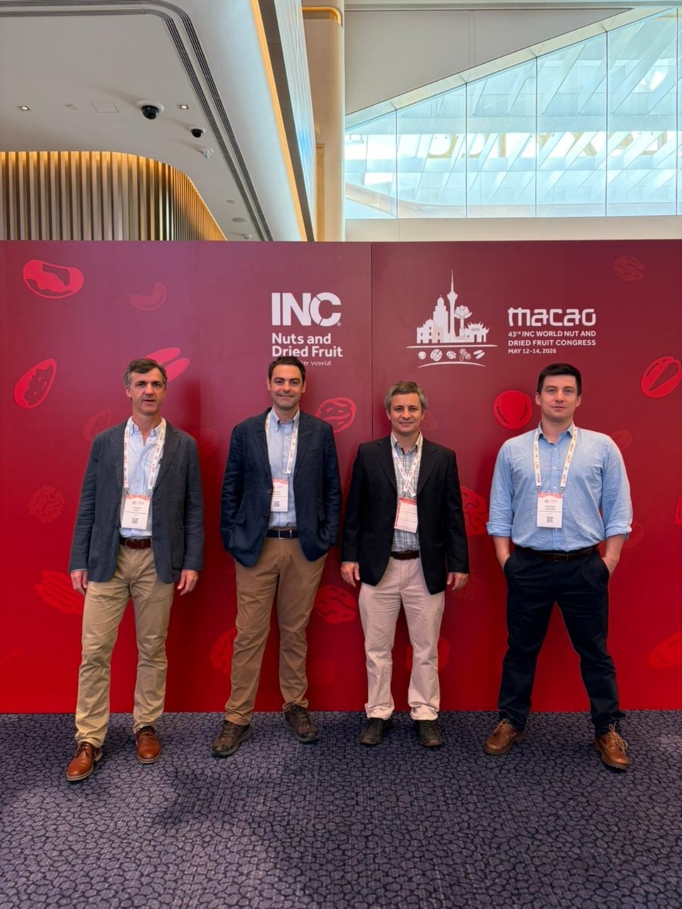
In the photo, from left to right: Joaquin Tagle, Rodrigo Lecaros, Gonzalo Infante, and Sebastián Aguilera.