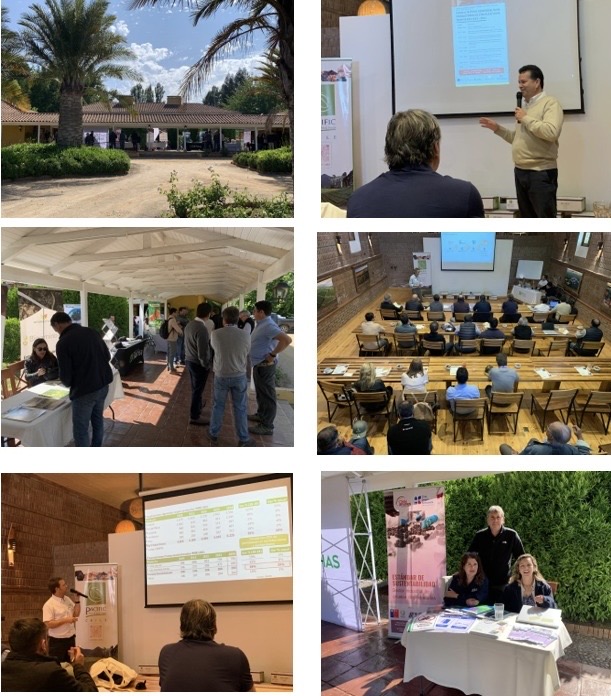
On Thursday, November 27, Pacific Nut held, as it has been the tradition for the last five years, a technical-commercial conference aimed at Agen plum producers, located mainly in the VI Region.
The event, held in the commune of Peralillo, featured welcoming remarks by Cristián Infante, the company’s general manager, who emphasized that the plum industry has been particularly robust, unlike other agricultural segments, and that both producers and exporters have experienced favorable seasons, with good returns and stable commercial conditions. “Plums have been a good industry for everyone. For that, we must work together,” he said.
China continues to be the most important market, he emphasized, demonstrating a structural change: it no longer only demands small sizes, but the entire range. The installation of local processing plants has driven this phenomenon and improved prices for fruit in natural condition. “While China has become a dominant and sometimes challenging player, as long as it drives the producer’s economy and generates fair returns, we will continue to go with the flow.”
The outlook for the coming season is optimistic: some areas show very good yields and others somewhat lower, but overall expectations are positive. Chile will end this cycle with virtually no carryover stock, allowing it to start next year with a clean slate and a competitive position in international markets.
Francisco Sutil, president of Pacific Nut, says he sees a bright future for Pacific Nut marketing plums. “We still have markets to continue developing and, honestly, the only thing I would ask for is to be able to count on more volume, because today we have more demand than supply.”
In the unique setting of the Hotel Viña la Playa, located in the middle of fields, he pointed out that “this shortage of supply allows us to market well, select well, and decide precisely where to direct the fruit depending on the market, whether in natural condition, pitted… In 2025, we have done a very solid job, and the results are clear to see. Now, if we manage to access more volumes, they will be more than welcome, because the demand exists and is growing.”
Domingo Calvo, commercial manager at Pacific Nut, states that “China is an attractive market, but concentration is a risk. The challenge is to diversify and strongly promote pitted markets in Europe, Mexico, and others.” Regarding the value-added strategy, he says that “we cannot lose sight of our goal: we must move forward with more elaborate products, especially pitted ones, which are the format most sought after by developed markets.”
He also said that Chile must continue to show the world that plums have positive attributes and that we can compete with quality, certifications, and zero residue. “Zero residue is a path we must continue to strengthen; it is what retailers are asking for and it is a huge opportunity to show that Chile can offer a safe, world-class product.”
Challenges and opportunities
The Chilean D’Agen plum industry is experiencing one of the most positive cycles in its recent history, with solid production levels, growing international demand, and global leadership that positions Chile as the world’s leading exporter and producer of this fruit, said Pablo Campino, member of the Chileprunes Technical Committee and assistant manager of dehydrated products at Pacific Nut.
“We are in one of the best cycles in recent decades, and that invites us to look ahead and reinvent ourselves based on success, not adversity. It is time to make strategic decisions that will allow us to sustain and expand this leadership,” he said.
Among these decisions, he mentioned advancing innovation and sustainability as structural pillars of the industry. One of the main challenges is to deepen more environmentally friendly agricultural practices, with a special focus on waste reduction, more efficient use of agrochemicals, and the adoption of bio-stimulants. “The invitation is to differentiate Chilean plums as a more sustainable product, with better practices and less environmental impact.”
He also highlighted the importance of closely observing the progress of regenerative agriculture, which emphasizes soil care, biodiversity, and the health of productive ecosystems, elements that can translate into both greater agricultural resilience and strong commercial added value.
From sustainability to the voice of producers
For his part, Pedro Acuña, executive director of Chileprunes, highlighted Chile’s strategic role in the global prune industry, as it accounts for a high percentage of global production. He pointed out that this relevance requires seriously addressing issues related to sustainability, a path that the association began several years ago and which today is consolidated with in-depth technical work, collaboration between producers, and a vision aligned with the social, environmental, and productive challenges of the industry. He also highlighted the quality of the team driving this agenda, thanking producers, advisors, and specialists for their commitment.
External speakers Eduardo Parra, technical manager at Green Hass, and Eugenio Liu, academic and partner at Tomate Consultores, were also warmly applauded for their presentations on the efficient use of bio-stimulants for plums and the circular economy, respectively.
The participants were pleased with the meeting. Producer Nibaldo Cornejo said, “For us, it is essential to gather valuable information and stay up to date on various topics in order to improve our orchards.” He also said, “We thought we had good water, but, after listening to one of the presentations, we realized that we have to be very aware of the pH. It was so revealing that our general manager ordered the tool -that was presented- to start measuring immediately.”
Alejandro Rivera adds, “I am a small producer, and I find this event very positive and educational. These types of spaces help Chile become the agri-food powerhouse it should be.”