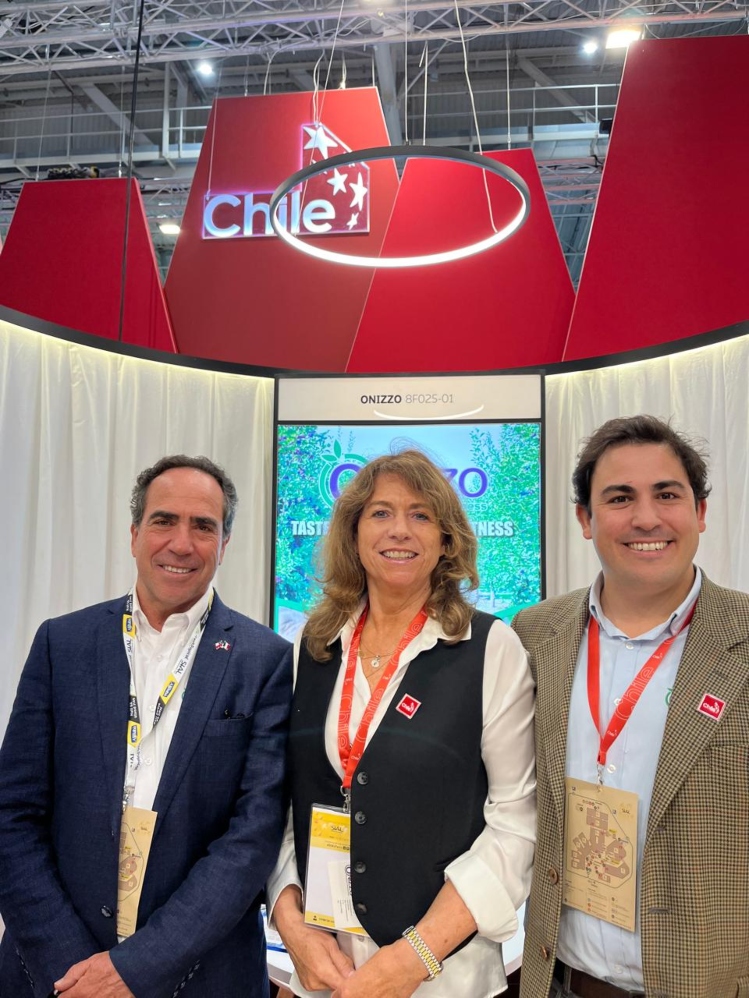
Claudia Marangunic, Export and Logistics Manager at Onizzo Exportations, is now an expert in international trade fairs.
Since 2011, she has attended almost all the Anuga trade fairs in Cologne, Germany, and the Sial trade fairs in Paris, France (they alternate every year). Thanks to these visits, she has gained in-depth knowledge of the European market, as both fairs are attended by customers from different countries who often do not have access to Chile because it is too far away. She also has the opportunity to meet new buyers from other continents who, from that moment, have become loyal customers for years.
“These fairs take place in October, which is when we have sold almost the entire harvest. But we get to reconnect with our customers; in this industry, close contact and getting together are highly valued, as it is very much a family business.”
How have international trade shows evolved over time?
“Every year, trade shows evolve thanks to technological support and advances in all areas. And something important: before, anyone who wasn’t in the industry could attend, try products, and do some sightseeing; but as their value increased, the shows became limited to people who come to do business, and I think that is better.”
She adds that all trade shows are very valuable, but due to time constraints, one must choose the shows that best suit ones needs. For this reason, his colleague in the commercial department, Agustín Marín Cobo, attends trade shows such as Gulfood in Dubai, PLMA in Chicago, and Apas in Brazil, among others.
Growing value
As a participant in numerous international trade fairs for around 15 years, Claudia Marangunic has noticed the growing value that dried fruits—including prunes—have acquired in general, a popularity that is due to global consumer interest in bringing healthy foods to their families’ tables.
In this context, Chile plays a fundamental role in the case of prunes, as the number one exporter of this fruit. “The Chilean industry is highly regarded among prune producing countries due to the good quality of the fruit and Chile’s reliability in fulfilling contracts. This is what we must do: continue to maintain high quality standards and promote the product through organizations such as ProChile,” she says.
At the same time, she adds, we must be prepared for the competition that will come in the next few years from China’s plum plantations and prune production. That is why it is important to have “eggs in different baskets,” even though “every time we meet with Chinese buyers, they want to take all of Onizzo’s production to their country.”
Onizzo’s diversification, depending on the year, covers a large number of countries, with China accounting for only 15% of the shipments. In addition, they are eagerly awaiting the expansion of the prune market in India, where Chileprunes is promoting the product. “There is tremendous potential, as the population is even larger than China’s and the consumption of dried fruit is enormous.”
The company’s sales will reach 3,000 tons by 2025, the same as in 2024, but with one important detail to mention: while in 2024 there was a large carryover stock from 2023, this year it is only fruit from the 2025 harvest.
“We ran out of fruit. Demand was higher than in previous years. That’s why we’re going to look for new producers to work with and thus increase the volume of fruit for sale.” In Onizzo, sales of prunes have increased by around 30% compared to 10 years ago, says Claudia Marangunic, who has a degree in English from the University of Santiago (USACH). Her entrance into the fruit industry came about circumstantially when she worked at Unifrutti Traders Ltda as an assistant to the president and then at GPK as an assistant to the general manager. At the latter company, she met Agustín Marín (senior), who hired her as export manager at Onizzo, where she has been since 2011.
Today, as Export and Logistics Manager, she is primarily focused on selling dried fruits, prunes, and nuts; communicating with customers in different countries; negotiating with shipping companies for maritime reservations; and scheduling shipments with the processing plant in accordance with the company’s contracts, among other tasks.
Onizzo Exportaciones, a company owned by partners Agustín Marín and Marcelo Oneto, already has a clear vision of the challenges for 2026: to make a strong entry into the retail market with packagings other than the 10 kg boxes they have been selling until now and, on the other hand, to obtain a greater quantity of prunes to sell. For this company, prunes represent a large part of the business, while they also deal in walnuts and garlic.
Photo: In the image with Agustín Marín, father and son.