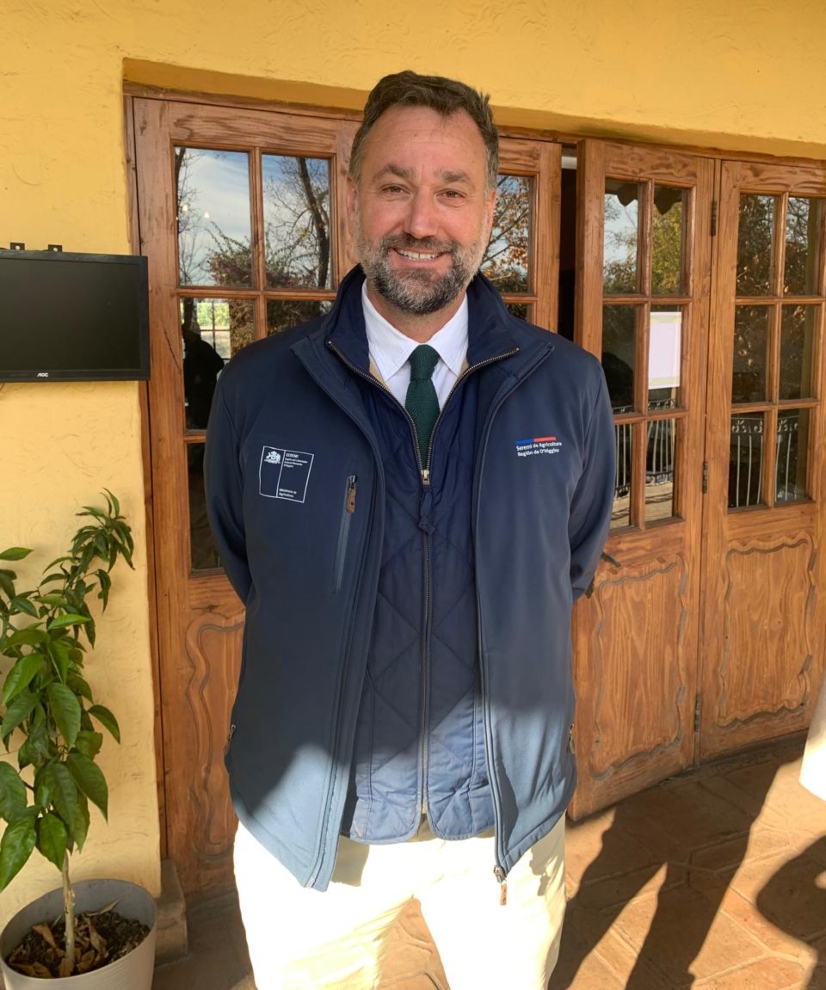
The new O’Higgins Region Regional Minister of Agriculture, Carlos Valdés Errázuriz, had previously noted in an interview that President José Antonio Kast asked them to “take their desks out onto the street.”
And that is precisely what he did when he joined us at the Hotel Santa Cruz for the presentation of the certification for processing plants and the signing of the new Clean Production Agreement (APL) for the implementation of the Sustainability Standard for the primary production of prunes.
“These certifications and signed agreements are very important for the prune industry. Each of these advances helps improve the quality and standards of our product, making it more competitive internationally and allowing prunes to maintain the prestige and value they have achieved in global markets. It is initiatives like these that help shape the future of our agricultural sector,” he notes.
How do you view the importance of the plum industry in the O’Higgins Region?
I have always been involved with plums—through the family business—and I am well aware of their contribution to regional agriculture. It is true that in recent years other crops have drawn more attention and taken center stage, but plums have a major strength: they have been a consistent presence over time.
What other characteristics would you highlight about this industry?
One of the industry’s strengths is that plums can be sold fresh or dried. This commercial versatility significantly expands market opportunities. Unlike other crops that depend on a very narrow marketing window, plums offer greater flexibility for storage and sale, allowing producers to better adapt to market conditions.
In addition, it has a well-established marketing chain and international demand that has sustained its growth over time.
How many people work in this sector in the region?
We do not currently have an exact figure, but we expect to have one in the coming months. Meanwhile, the Natural Resources Information Center (CIREN) is developing a fruit crop registry in the O’Higgins Region, using satellite analysis tools that will provide a more precise understanding of the planted area and the production characteristics of various crops, including plums.
With this information, we will be able to make better decisions. In some agricultural sectors, we have seen very rapid expansion cycles followed by problems of oversupply or market difficulties. Having reliable information helps prevent such scenarios and allows us to plan for future development in a more sustainable way. In the case of plums, having this data will be invaluable for projecting the industry’s growth.
Carlos Valdés, a native of Graneros, holds a law degree from the University of Chile and has completed graduate studies in comparative law in the United States. He returned to Chile in 2013 after spending time abroad to devote himself to family-run agricultural ventures in the region.