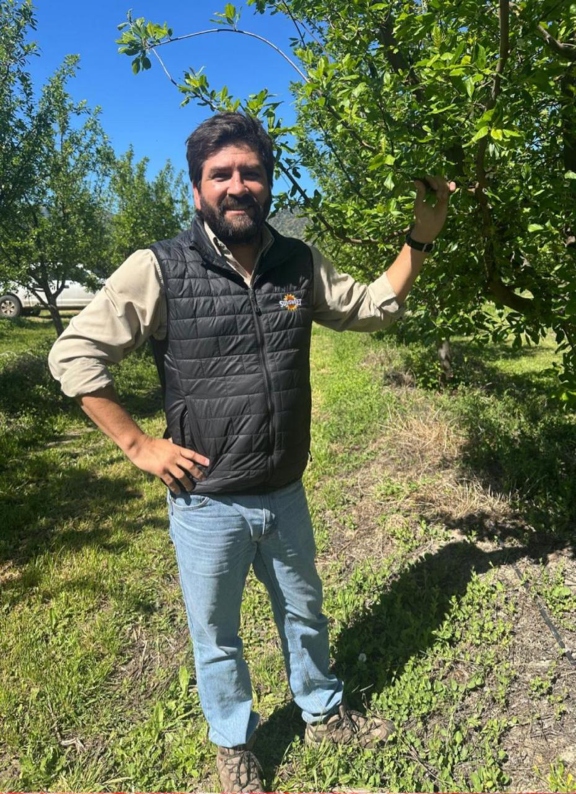
Generally, the year is looking good for prunes, though in the agricultural world, victory can never be declared until the end of each cycle.
The process began in June or July with pruning. “This is where the tree is structured and the desired fruit load is defined. The work done at this stage is reflected throughout the development of the season,” says Jorge Sánchez, Grower Relations at Sunsweet.
This year, the O’Higgins and Colchagua region—the heart of the country’s prune production—faced a winter with fewer chilling hours than the prune trees require: nearly 100 hours less than last year (which closed at around 700 chilling hours). To make up for this deficit, many producers once again turned to hydrogen cyanamide, a product that helps to homogenize orchards and speed up bud break. Even so, the start of the season is running 5 to 7 days behind last year, something Sánchez doesn’t consider serious.
“What’s most concerning isn’t the beginning, because the timing tends to even out. The truly delicate point is how the orchards reach the veraison stage, between Christmas and January 5, when fresh fruit monitoring begins,” he explains.
Another factor of uncertainty this year has been the rainy spring. On September 18, in the Colchagua region, an average of 28 millimeters fell, over a short period of time. The following weekend, 15 to 20 millimeters fell, concentrated in two hours. Although rain is welcome in winter, at the height of flowering, it can cause fungal and disease problems, forcing producers to apply more fungicides than usual.
“The rain in late September and October is not beneficial: it complicates flowering, cools the soil, and impedes growth. The positive side is that it ensures more water for irrigation in October, in a context where access to this resource remains critical,” he notes.
Overall, Sánchez is optimistic; the production outlook is promising. “This season reminds me of 2023, which also had a cold and rainy spring but ended up being good. Every year is different, and the key is taking care of the orchards from the ground up: good pruning, a well-maintained tree, and a balanced crop load. Ultimately, quality is rooted in these fundamentals.” He adds that “we are not seeing overly loaded orchards, which is a positive sign. A balanced load ensures better-quality fruit,” he comments.
Workforce Challenges
Beyond the climate, one of the greatest structural challenges facing the prune industry today is the availability of skilled labor.
According to Jorge Sánchez, pruning and harvesting require experienced workers who know how to “read” the tree, make the right pruning decisions, and then select the fruit judiciously. However, in recent years, the labor supply has been drastically reduced, driving up costs and affecting the quality of the process.
“Labor is more expensive and less experienced. Young people are not showing interest in the sector, and many producers must turn to contractors, a move that often leads to higher costs.” He also notes that some workers coming from previous harvests of other fruits have sought to earn the same daily wages as in those specific sectors, which is difficult to match for the prune industry.
Sánchez explains that the arrival of foreign workers has proven effective in post-harvest operations (drying fields), and has been key to sustaining operations in many productive areas.
Sunsweet is located in Santa Cruz, at the heart of the production zone. Its processing plant and drying ovens are located there. It works with producers distributed from Paine to Retiro, totaling approximately 1,200 hectares in production. The company’s projected production is approximately 16,000 tons of fresh plums, equivalent to approximately 5,000 tons of dehydrated prunes, destined for export.