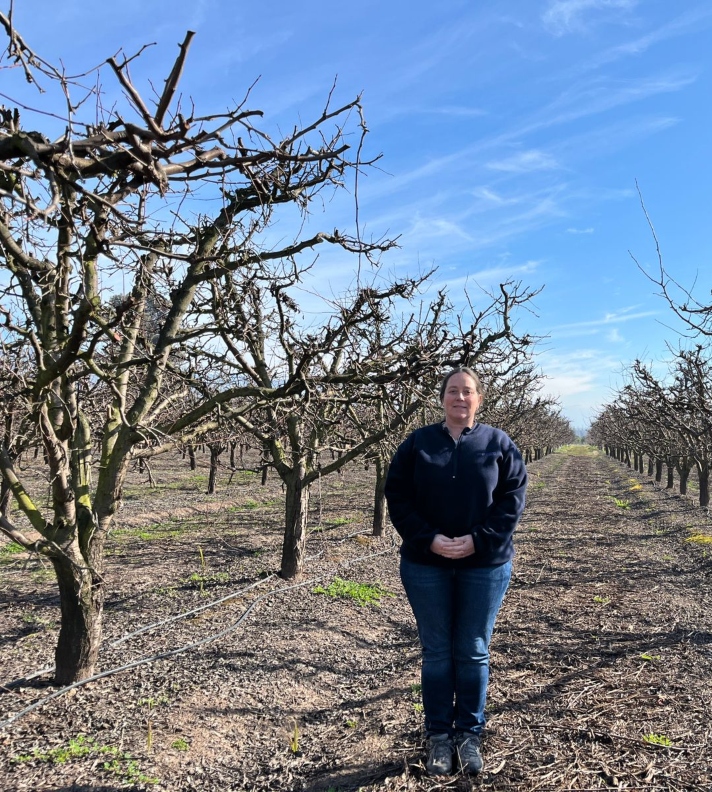
Rosario Larraín, regional agronomist at Prunesco makes a balance in the middle of the winter season.
The winter advances in the European plum orchards with normal agronomical management and a satisfactory total of cold hours up to the moment. Nonetheless, the main concern is the low amount of accumulated rainfall during the season.
“We are in the middle of winter and the pruning is taking place in a normal way, regulating loads for a normal year. There is no overload nor extreme pruning. This is a sign that the producers are hoping for a season without any shocks”, says Rosario Larraín, regional agronomist at Prunesco.
Regarding whether conditions, the expert comments that “even though May was warm and this situation delayed the beginning of the winter recess, from mid-June the accumulation of cold hours started properly. Up to date, we have already about 550 hours in the Colchagua region and even more in some other places”. It is not the optimum, but it is a number that gives reassurance. Regarding the spring blossom, she adds, we will pay attention to the temperatures in September.
The main concern is the rainfall. During 2024 there were more than 600 mm with an intense event on June. This year there have been only 270 mm in the Colchagua area, in the VI Region, the most important for the prune. It is less than half of what we had last year and, so far, regarding July, we hope that the rain forecast for the last week of July becomes a reality.
“We are worried that there will not be enough water in dams and reservoirs, and not enough snow in the mountains to ensure watering at the end of the season”, she explains. Ideally, she says, at least 500 mm of well distributed rainfall are needed to keep good humidity in the soils and to face spring and summer in a good manner. “An isolated big event does not work if the soil is already saturated. It is better to have several smaller events”.
When asked about the effect that this irregular winter can have in the blooming, Larraín clarifies: “a good accumulation of cold hours and mild temperatures during blooming, between 16 and 25 C°, can produce a more even opening of flowers and so a better set. There are problems when the extreme temperatures affect the viability of the pollen”.
Regarding field work, both pruning and harvesting are more and more mechanized. Nowadays, harvesting is done with teams of about eight persons thanks so side by side machinery and more technified drying fields. In the same way, there have been added semi-mechanized pruners with pneumatic scissors that make the work easier and faster.
The use of cyanamide hydrogenated has also been increased to homogenize blooming and, in certain cases, it can advance the harvest of fruit to be consumed fresh. Even though this only represents a small percentage of the production, its impact in the national volume of dehydrated fruits is about 20%.
Finally, regarding the structural challenge of labor, that is still a factor, some balance has been achieved due to labor rotation with workers from the cherry sector. “Labor is still scarce but improvements in mechanization have allowed to compensate this difficulty in some areas of the productive process”, adds Rosario Larraín.