During winter, heavy rains can flood the soil and make it difficult for traditional machinery to enter the orchards. This in the middle of a crucial time to apply preventive treatments against diseases related to the wood of the plum trees.
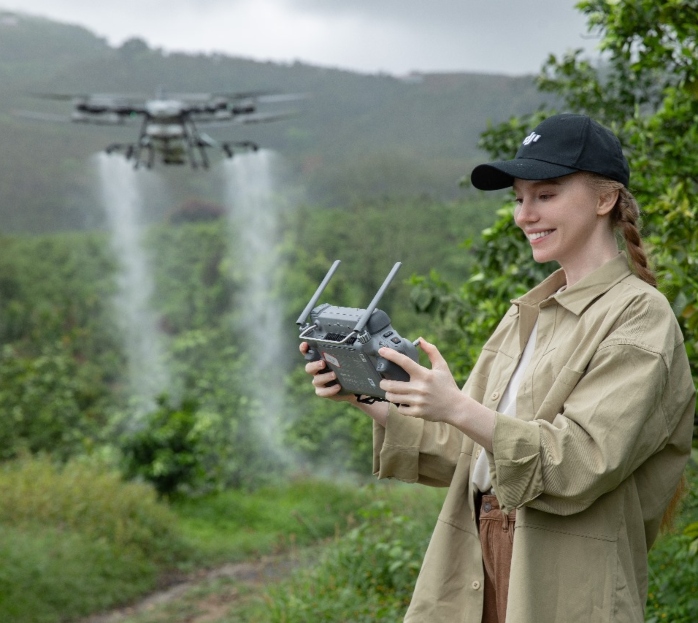
Spraying drones are an important solution for this problem.
Sumit Agro Chile, a Japanese multinational company specialized in sustainable agricultural inputs, that has been in Chile for ten years, launched globally on Tuesday, March the 15th through AgriTech services, two new drone models: Agras DJI T100 and Agras DJI T70P.
Claudio Valdés, assistant manager of AgriTech and Seipro says that “these models can achieve important changes in the Chilean agriculture. DJI T100 is a greater scope drone with a 100-liter tank (a previous model only had a 40 -liter tank) which allows more autonomy. It has a triple function; besides spraying, it can apply solids like seeds and fertilizers up to 150 kilos and to carry loads from A to B in an orchard, fruit or inputs for example, up to 100 kilos”.
Agras T70P, he adds, also has triple function but it has a smaller tank, 70 liters, and it can spread solids and it can lift loads up to 70 kilos.
This is a revolutionary technology for the Chilean Agriculture, says the expert from AgriTech because it is a unique advanced technology, with triple function that improves productivity and diminishes environmental impact.
Nearly 80 thousand hectares of fruit and crop orchards are being flown by DJI Chinese drones. Agras DJI T100 and Agras DJI T70P are models that are a continuation of the drones offered previously by the brand but before they only had the spraying function.
The launching in Chile was a double one: the first one, on July the 22nd took place in Club de Golf Los Lirios in Rancagua, and the second one was on July the 29th in The Country Club of Temuco.
The total sales projections are more or less 500 units per year for both models combined.
Going along with the prune in different stages
This DJI drones can be important in three different stages of the productive process of the prunes: from protection against diseases during winter, applying treatments during blooming, sun blocker applications and drying during other seasons.
First, these drones, since they operate from the air, solve the problem of applying bio fungicides and protecting thus the trees without the need to wait for dryer soils.
Second, during blooming, it is necessary to apply preventive substances to avoid diseases that affect the set and development of the fruit. Here, drones are key again for the application of fungicides and bio-stimulants in a uniform way without affecting the structure of the soil and without compromising the quality of the crop. Even more, its autonomous and programmable capacity allows night time applications optimizing the inputs.
Third, once harvested, the plums are put in sun drying fields. Drones not only make it easier to apply disinfectants in these fields but, thanks to the power of their propellers, they help turn the plums so they can dry in a uniform way. This capacity reduces hand labor, speeds the process and minimizes contamination risks.
“These devices not only improve productivity and reduce costs, but also allow precise applications in critical moments during the process. Drones have proved to be an innovative, efficient and sustainable solution”, says Valdés.
Drone technology in agriculture has been used in Chile since 2015 and it is estimated that today there are from 800 to 1,000 drones operating in the country.