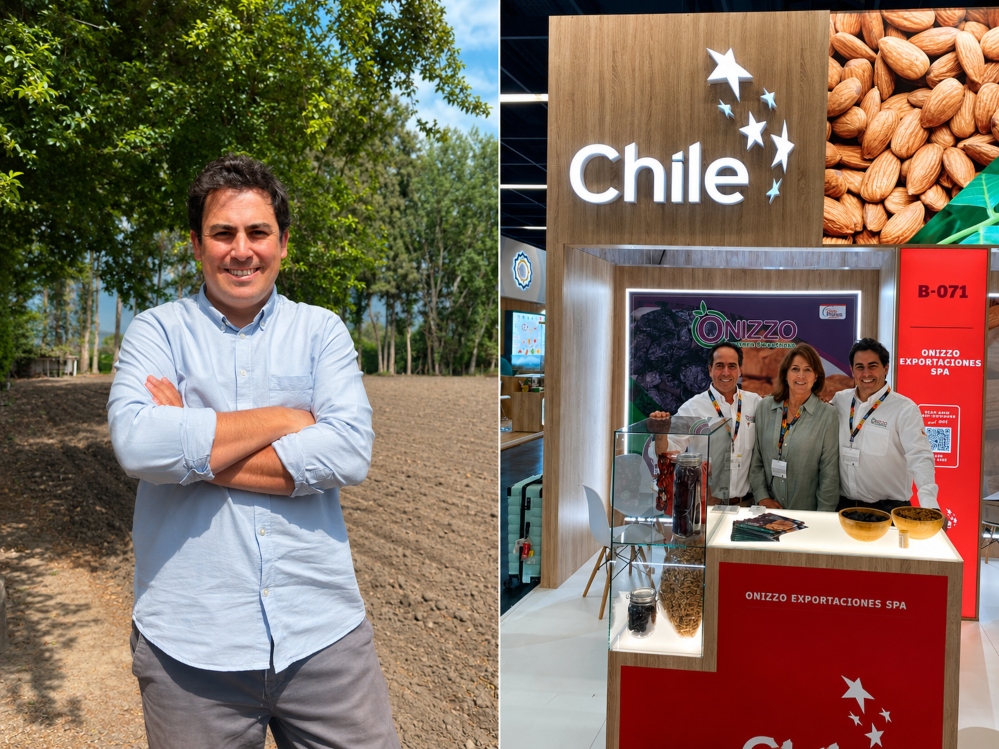
Agustín Marín Cobo, Commercial Manager at Onizzo, shares his perspective on how the export company has grown over time and explains that prunes are clearly its star product, accounting for approximately 70% of the company’s total shipment volume.
In addition, they work with walnuts and raisins and offer a fresh garlic program during the summer. They had stopped selling raisins for a while, but resumed the business this year, so they once again offer their three traditional dried fruit products.
When it comes to plums, Onizzo ships to more than 30 countries, sourcing from about 35 suppliers located in the Metropolitan and O’Higgins regions.
For Onizzo, how has the prune business evolved this year?
It has been a season with very high-quality fruit and an excellent level of sweetness, which has allowed us to achieve good commercial yields.
We are not agricultural producers, but exporters, and what has grown is the volume we handle as a company. As for prunes, last year we exported 3,200 metric tons of finished product, and this year we project reaching 3,600 metric tons, including pitted and unpitted prunes that have been softened, as well as product in its natural state.
What is driving this growth of over 10%?
It’s not due to a single event. It’s the result of a long-term strategy we launched about seven years ago. At that time, we set out to reach this volume by 2025–2026, and we continue to move in that direction. I wouldn’t be surprised if, within two years, we are close to 4,000 tons, establishing ourselves as a major player in the industry.
In a market where price is often the deciding factor, how do you manage to stand out?
Our focus has always been on selling quality, building our brand, and providing excellent customer service. It may seem challenging in a market where everything is often measured by price per kilogram, but in the medium and long term, quality ultimately prevails.
When a customer receives a consistent, top-quality product, they eventually come back to buy more. It is also easier for them to market a product whose quality they know and trust. That trust also allows them to secure better prices. It is not an immediate process, but one whose results solidify over time.
Thinking About the Newer Generations
What trends do you see in terms of consumption and packaging formats?
I believe that, from a marketing perspective, the prune industry still has work to do. We need to make this product more appealing to the newer generations.
It’s not an easy challenge, because visually, the prune is not a particularly eye-catching product. However, we do have some very strong attributes: it is healthy, sweet, tastes great, and aligns perfectly with healthy eating trends.
In addition, the Chilean industry has succeeded in developing a product that makes our customers’ jobs easier. Our prunes are well-suited to consumer formats such as 100- or 200-gram packages, allowing us to develop a variety of presentations for the end consumer.
Beyond the product itself, there’s another key differentiator: reliability. We offer high-quality fruit, but we also ensure on-time and reliable delivery. That consistency is an attribute our customers value immensely, and it ends up being just as important as the product’s quality itself.
Market and International Competition
Despite greater diversification in destinations, China remains the most important player for the industry. Is it also the priority market for Onizzo?
China is a market that is impossible to be ignored. One way or another, we all end up selling our products there. However, our focus has always been on protecting the added value generated by the Chilean industry. When we talk about added value, we mean leveraging the industrial capacity established in Chile and avoiding becoming merely suppliers of raw materials exposed to market fluctuations.
For this reason, our target market has not been—and will not be—exclusively China. We sell there, but under one very clear condition: that they are willing to pay a price equivalent to what we command in traditional markets such as England, Germany, Spain, or Mexico. If that condition is not met, we prefer to continue supplying those markets, which have valued our product for 25 years and where that added value is truly recognized.
That is our approach, and we know of other players who are doing the same. I believe this is an attitude and approach that the entire industry should adopt.
How do you view international competition, particularly from China and Uzbekistan?
China has done significant work in developing new varieties. They have incorporated European genetics and developed a variety known as Xin Mei, which performs well as fresh fruit. However, when used for the drying process, it remains a different product from what Chile produces.
They still have lower crop yields and lower productivity per hectare than Chile. That does not mean they cannot catch up in the future—they have demonstrated tremendous capacity for development—but today they’re still at a different stage.
In the case of Uzbekistan, they primarily grow the Stanley variety, which is different from the D’Agen variety typical of Chile. Furthermore, they supply different markets—mainly China and Russia—so they do not compete directly with our product in traditional markets.