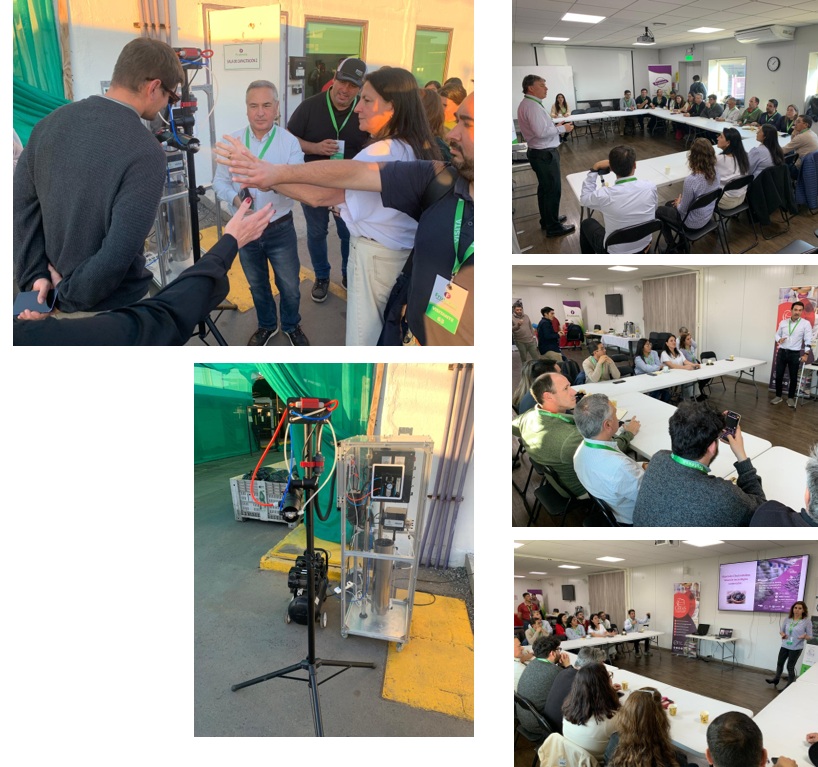
In line with Chileprunes’ efforts over the past three years to establish a Sustainability Standard for the Prune Agro-Industrial Sector, this organization, together with Frutexsa, hosted a meeting in late April on Technologies for Prune Processing in Chile.
The event, held at the company’s offices in Buin, was attended by professionals from companies associated with Chileprunes, among others, who received valuable information regarding existing technology to reduce water consumption and the use of potassium sorbate in prunes through an electrostatic spraying system using Fullcover equipment (developed in Chile by IngeAgro).
Among its most significant benefits are water savings (52% less) and a lower actual loss of potassium sorbate: while conventional spraying results in a 29% loss, the electrostatic system results in only a 10% loss of this chemical preservative.
Another difference from the traditional spraying method is that this electrostatic system improves the distribution of the compound on the plums and its penetration (in a more uniform manner), which helps prevent the growth of molds and yeasts, thereby extending their shelf life.
Additionally, it maintains a stable potassium sorbate concentration over time, particularly in response to temperature changes; this is coupled with the generation of positively charged microdroplets, causing them to effectively adhere to the plums (which have a higher negative electrical charge).
The payback period is 2 years when processing 4,000 tons/year of prunes. Or 1 year, if more than 7,000 tons/year are processed.
A United Industry
For Matías Aninat, Operations Manager at Goodvalley, it is essential that we come together as an industry to identify opportunities for improving quality; to discuss the developments the industry needs, and to stay up to date and modernize.
Claudia Pinochet, Sustainability and Quality Manager at Frutexsa, emphasizes that as the event’s host company, they deeply value innovation and all initiatives that make processes more efficient.
“The industry must stay ahead of global demands, moving toward processes with fewer preservatives, lower water consumption, and reduced energy use, implementing these solutions not only on a pilot basis but also at an industrial scale and in line with the sector’s real needs.”
In this regard, he notes that the partnership between the prune producers’ association (Chileprunes), CORFO, and CREAS represents the path forward, driving the development of new technologies and strengthening the competitiveness of the Chilean industry relative to other countries.
Alejandro Osses, director of CREAS—the Food Science and Technology Center, located in Valparaíso—highlights the value of fostering opportunities for collaboration among companies that might even be competitors, but who choose to share knowledge and work together to drive innovative solutions.
In his view, these types of meetings are “virtuous” because they connect technology centers, equipment suppliers, and an export industry seeking to improve its processes, responding to increasingly demanding challenges in sustainability, efficiency, and competitiveness.
At CREAS, he explains, researchers, scientists specializing in food science and technology, development engineers, and technology professors work as part of the TT Green Foods program, funded by CORFO, an initiative that seeks to promote technological and sustainable solutions for the food industry.