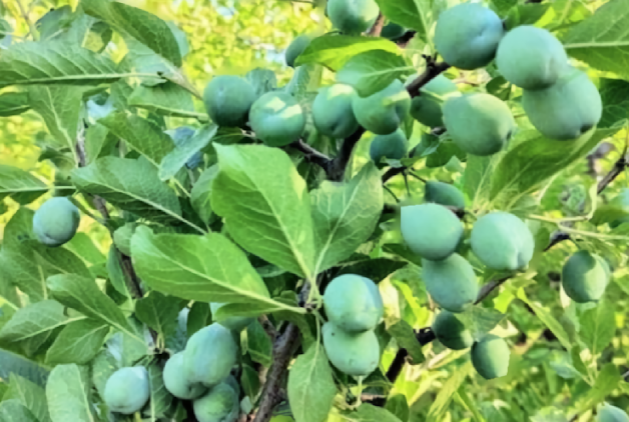
Agricultural engineer Rosario Larraín, agricultural manager at Prunesco, and Óscar Astorga, member of the Chileprunes Committee and general manager of Superfruit, talk to us in the field about how the plum trees are developing.
The first explains that, in general terms, flowering was good. The rains in September in the Colchagua area—which accounts for the largest number of hectares—were in an advanced stage of pollination. “Everything indicates that there will be a similar amount of fruit to previous years.”
This uneven flowering occurs at all levels: within the same region, province, or even between vineyards just a few kilometers apart, she points out. “For example, between Colchagua and Pirque, there is up to a 10-day difference in the start of flowering, which means that rain affects two stages with different sensitivities,” says the specialist.
There are even disparities within the same tree. First, the lower 50% of the tree blooms, followed by the upper part. “There is a disparity within the same tree, which, depending on the weather at the time, can result in up to a week’s difference in fruit formation, a gap that shortens as the harvest date approaches (which under normal conditions is between February 8th and 10th).”
However, in the most important areas of Colchagua—Chépica, Santa Cruz, Peralillo, among others—there were high concentrations of fruit, which required some mechanical thinning. Moving towards the coast, yields were lower than average. As for the Metropolitan Region, lower and irregular yields were observed in the eastern mountain range, while further inland, for example in the Melipilla area, normal yields were seen.
With regard to irrigation, the season has begun with good water availability. “At this moment, the concern is to irrigate properly in light of the high temperatures of recent days,” although there is uncertainty about how the water season will end.
Perspective from Superfruit
In a brief summary of the winter, it should be noted that the pruning process was fairly normal, with the necessary labor available for the job.
During those months, there was a satisfactory accumulation of cold hours for the species. A plum tree needs 45 cold hours during the season. “For the field where I am (Ranguil area in the province of Colchagua, VI Region), the record was 60.5 cold hours,” says Óscar Astorga, member of the Chileprunes Committee and general manager of Superfruit.
However, comparing this season with the previous one for the coastal area, there has been lower accumulation, with a record of 11% less, he says.
Thanks to the accumulated cold spells, spring sprouting or blooming underwent a normal process. However, there were a few millimeters of rain during flowering; therefore, preventive applications of fungicides were relevant.
“Cyanamide has become an important tool for many species, providing us with uniformity in sprouting and allowing us to get a little ahead of certain stages of the plant. Ultimately, it is being used in concentrations determined by each producer.”
Regarding rainfall, compared to last season, there was between 100 and 200 millimeters less, depending on the production area. This year’s rainfall was lower than in 2024 and 2023, but higher than in 2022.
Was enough water collected in dams and reservoirs?
“The accumulation was delayed, but it was achieved. In our case, it took us two months longer to reach 100% capacity, assuming the electricity costs involved in pumping water. In any case, we had more water from direct precipitation into the reservoirs and from surface runoff from the streams. In short, we achieved our goal of accumulating the necessary cubic meters for this season.
Were there significant climatic disparities between one area and another within VI Region?
Yes, there were significant climatic disparities between areas within VI Region. There were differences in both precipitation and the accumulation of cold spells and temperatures of the days. The latter are especially important for fruit development and, to date, show higher values than last season.
This scenario has led to certain phenological stages occurring earlier than usual in some areas, such as stone hardening, which suggests that harvest could be a few days earlier than last year. However, there is still some of the season left, so it is necessary to continue monitoring how the crop develops, concludes Óscar Astorga.