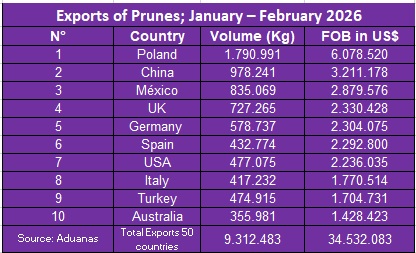
For many years, China had never relinquished its top spot—whether monthly or annually—as the primary destination for Chilean prunes. Now, that day came, and today, it ranks second in volume (metric tons) and revenue (FOB dollars)—after Poland—with figures hovering around 978,000 kilograms and US$3.2 million, respectively.
The decline has been drastic, representing only 37.5% of the volume recorded during the same period last year, when exports reached 2,607 metric tons (and US$5.98 million).
In terms of destinations, Europe strongly leads the shipments. Poland stands as the main market, with purchases of 1,791 metric tons, equivalent to US$6.07 million, consolidating its position as a key strategic partner for Chilean prunes.
The United States and Spain also report positive news:
At the strategic level, the United States increased its volume by 32%, and its unit price rose from $4.43/kg to an average of $4.69/kg for the period, although in February alone it had already reached $4.88/kg.
In Spain, although export volume fell slightly, FOB value increased. The February snapshot shows that the price jumped from $4.80 to $5.91/kg (+23%), establishing itself as the market with the best return per kilogram, which suggests positioning higher-value-added or premium products in this market.
According to figures from Chilean Customs, exports in the first few months of the year totaled 9,312 metric tons, equivalent to US$34.5 million FOB, reflecting a strong start to the season for the industry.
Mexico remains a key market, with exports exceeding 835,000 kilograms and reaching nearly US$2.9 million, leading the way in Latin America.
The United Kingdom and Germany, both with shipments exceeding 570,000 kilograms and values close to US$2.3 million, reflect the strength of the European market.
The United States, with over 477,000 kilograms, US$2.2 million, remains a key destination in North America.
Other notable markets include Spain, Italy, Turkey, and Australia, reflecting the diversification of destinations and the stability of international demand.
In Latin America, in addition to Mexico, markets such as Brazil, Colombia, and Peru stand out (based on historical trends), and continue showing sustained growth in consumption of this product.
These figures indicate a lower concentration in a single market compared to previous years and reflect an increasingly diversified export strategy on the part of the industry.
Chile is the world’s leading producer and exporter of prunes, bringing this superfood to consumers on different continents and reinforcing its reputation for quality, availability, and nutritional value.
The information is based on official data from the Chilean National Customs Service.